Sunday, June 29, 2014

Competition Day 4 and International Night


WGC2014 – Räyskälä, Finland
28 June   (Fourth actual competition day)
by John Good

 
This morning’s sky was again beautifully clear, and this time the day delivered something close to what these attractive morning conditions promised.  The result was the best racing day yet, with excellent speeds and only a little rain to dodge.

The tasks were the longest yet, though just a bit short for weather this good.  The Competition Director noted that the initial idea was for a “grand tour” task that circumnavigated the large controlled airspace area surrounding the city of Tampere, located about 50 miles north of here.  (Why a city of 150,000 needs an area of closed airspace worthy of Philadelphia is a bit of a mystery.)

Such a task would have been about 500 km, and probably within the capabilities of the 20-Meter and Standard class gliders.  But the forecast for some chance of rain led to a decision for shorter tasks that stayed closer to home.  The winners in those two classes completed their 350-km tasks in a bit under 3 hours, which causes the winning score to be reduced below 1000 points – a trifle disappointing for what could prove to be the best day of the contest.  But enough pilots dodged enough rain showers late in the day to limit the grumbling about undercalled tasks.

The improvement in weather has encouraged Finland’s insects: all gliders returned today with a good number of them smashed on the leading edges of wings.  It may soon be time to carry those troublesome bugwipers.  On the ground, mosquito repellent is starting to come out of storage and into use (a bright side to our cold weather has been the suppression of what can be a major nuisance at this time of year).


The evening’s big social event was International Night: all teams are encouraged to serve food and drink typical of their country.  This was a huge success here at Räyskälä – hundreds of people attended (but there was plenty for all); no one left hungry, and few 100% sober.  The US Team served grilled hot dogs on buns, with all the trimmings (they were seriously popular).  Team Australia offered wine and also Vegemite, a yeast extract that is spread on bread or crackers.  This has the appearance, consistency and some say, the flavor of road tar, but I happen to love it.

 Team Brazil whipped up a dangerous concoction known as caipirinha, which includes limes, sugar and cachaça (sugar cane distilled into fire water).  And if you plan on operating machinery or even walking a straight line, be careful when a smiling Janusz Centka (several time world gliding champion from Poland) offers you a small quantity of clear liquid.  At WGC2010 it was some variant of Slivovitz; here it was vodka. 


Saturday, June 28, 2014

Morning preparations...


Competition Day 3


WGC2014 – Räyskälä, Finland
27 June   (Third actual competition day)
by John Good
 

This morning offered the most promising sky we’ve yet seen: nearly clear (which in Finland means crystal clear), with some high clouds receding to the southeast.  It looked as if it could be the start of a classic soaring day (a species rather rare in Finland this year). 


But it didn’t really work out that way.  By launch time cumulus clouds filled the sky and several were towering to heights that portended problems.  All pilots found some good (occasionally excellent) lift, but all had to pick their way around rain showers, wet areas, and spreadout cloud.  A memorable radio transmission from Garret Willat to Sean Franke illustrates some of the complexities of flying in these conditions: “Maybe we should try to stay above the freezing level, so we can fly in snow rather than rain” (the point being that dry snow readily slides off wings and thus doesn’t degrade glide performance as much as rain).


Some very good speeds were recorded, especially in Standard class.  This apparently involved running a shelf of cloud close to a line of towering cumulus clouds.  Such a shelf can offer terrific lift, but also severe gusts, lightning and possibly dangerous hail. Today, it worked well for those whose timing allowed them to find it in the right state of development.   


The more conservative approach was to detour away from the approaching rain.  This was the strategy employed by the Finnish pilots, who tend to be very savvy about the vagaries of Räyskälä weather (some of them are professional meteorologists).  The US Team followed their lead, but it didn’t prove to be the right way to bet today.  Three of our pilots got home, though not with impressive speeds.  Phil Gaisford wasn’t able to climb away from 1200’ in rain, and landed in a good field.  Heinz and Karen flew through extensive rain and eventually had to use the “iron thermal” (their glider’s sustainer engine) to get home.

Continuing the theme of things that are different in Finland, I’ll mention towropes.  In the US these are typically polypropylene of 3/8” or 5/16” diameter, generally held to have a breaking strength around 1200 lbs.  Here at Räyskälä, the material is the same, but the diameter is around an inch, yielding a rope that would serve to moor a fair-sized cruise ship – I’d be surprised if the strength when new is less than 15,000 lbs.  (A mechanical weak link at both ends protects towplane and glider in case of problems.)  A towrope like this weighs a good 20 pounds or so, which yields an evident “sag” in level flight.  

The Finnish language is a major curiosity for visitors.  It has an interesting and not unpleasant sound, but bears no detectable relationship to any other language.  (Linguists are said to discern similarities with Hungarian, but native speakers of these two languages apparently don’t see any.)  For most visitors, this makes problems: Finnish words have nothing in common with any word you can recognize – indeed, if you find any connection at all, it’s probably because the word is one that Finnish has borrowed from another language (e.g. “kahvi” is that drink you enjoy with breakfast).

An example of the possible confusion came during a broadcast of one of the World Cup games: early in the second half the Finnish announcers were frequently heard to refer to “Ooksi Ooksi” which sounded as if it might be the name of one of the players (later on, his brother “Cocksi Ooksi” was apparently on the field).  But no – this was the score: Ooksi was actualy “yksi” (one) and Cocksi was “kaksi” (two).  (The first five numbers are: yksi, kaksi, kolme, nelja, viisi.)

To be fair, Finnish pronunciation is regular and reasonably familiar – an English-speaking visitor can say place names without much embarrassment after only a little practice (try that in Polish – or better yet, don’t, if you wish to avoid confusing both Poles and English speakers).  A helpful rule is that the accent invariably goes on the first syllable.  The sounds don’t precisely match, as we guessed from a sign on a Rayskala water tap that said “Do not trink”.

Smoking seems to be tolerably common but declining in popularity.  Just a few years ago rules changed such that smoking is no longer allowed in restaurants and public buildings – so the sight of smokers huddled outdoors is as commonplace as in the US.  Finland smokers unfortunately seem to share the view of those elsewhere, that “the world is my ashtray”: cigarette butts are a common form of litter in a country that is otherwise notably spic and span. I haven’t checked the price of cigarettes, but I expect it is quite high: Finland is not shy about taxing what are perceived as vices (the cost of beer here is evidence of this).

Thursday, June 26, 2014

We are racing!


WGC2014 – Rayskala, Finland
26 June   (Second actual competition day)
by John Good


Our patience has been rewarded with weather that allowed a couple of days with genuine soaring tasks. 


 It would have been far too much to expect that the flying be trouble-free, and it certainly hasn’t.  Finland’s “summer without a summer” continues.  We’ve had much cloud and low temperatures – pilots have had to pay a lot of attention to the problem of finding lift under a solid overcast, and sometimes in rain.
 

Yesterday’s tasks went well for three US pilots, and not so well for three others.  The unfortunate ones were Bob Fletcher (who encountered little but rain after his start and landed only about 25 km out), and Heinz and Karin (who made several relaunches and thus got out on the task far too late to complete it). Phil Gaisford got around a troubled Standard Class task.  Sean Franke had an excellent flight and finished second in Club class; Garret Willat had the best distance among the non-finishers, which earns a respectable score on a day when many pilots don’t get home.

Garret’s outlanding was in a good field that he’d scouted (on the ground) during the practice period.  This “homework” allowed him to press on into an area that otherwise offers very unattractive landing options (of which the best is a lake).

Today’s weather was just a bit better.  There was still plenty of cloud  and rain showers to dodge, but lift – often under near-solid cloud layers – was consistent enough to get most pilots around their tasks.  Sean and Garret had decent flights (at 90 and 88 kph).  Sean’s 13th place for the day, puts him in second place overall, just one point out of first.

Most pilots in Standard Class delayed their start for quite some time, in view of trouble evident at their first turn area to the south.  When they did finally set out, It seemed that the chances of many complete tasks was small.  But the class generally stuck together, found the lift they needed, and mostly got home, Bob and Phil included.  Bob finished 13th – a big improvement over yesterday.  But Phil got very bad news: in a pre-start thermal he’d made a short excursion into closed airspace, and thus receives no points for the day.

 
Beyond the nature of Finland’s summer weather, some differences are notable here: You’ll look long and hard for a pickup truck. When Finns wish to move stuff around, they use utility trailers (which explains why a high percentage of vehicles have tow hitches - and not just those found at glider contests).  In deference to the climate, these trailers often have large molded plastic covers.  This very practical approach is no doubt in part a response to gas that’s currently costing us $8.50 / gal – an amount that would make a vehicle with the mileage of a pickup an extreme indulgence.

Supermarkets always provide useful points of comparison between countries.  Take mustard, for example: in Finland, this is commonly sold in large toothpaste-like tubes, which actually work well for spreading mustard on bread or meat.  As with most food items here, the variety is impressive.  Unlike some, mustard containers typically include some useful hints in English as to the nature of the contents.  I bought some labeled “Prepared mustard strong” and have not been disappointed.

At all markets it seems you’re expected to bring your own bags (or pay for the ones you need) and to bag your own purchases.  Carts are reasonably small, and typically have 4 fully castering wheels.  If you select produce, you should weigh and label it before you arrive at the checkout.  Most items are expensive by our standards – to pay the same price here in Euros (at $1.36 each) as you do in dollars at home means the item is fairly cheap.  Quality seems uniformly high.

A final point concerns car models, which in Finland are similar but not identical to what’s found in the US.  Ever run across a Nissan Qashqai?  I saw a couple of these small SUVs today.

Wednesday, June 25, 2014

We take-off on Day 1

 
 Phil Gaisford - Discus 2b

Bob Fletcher - ASW-28

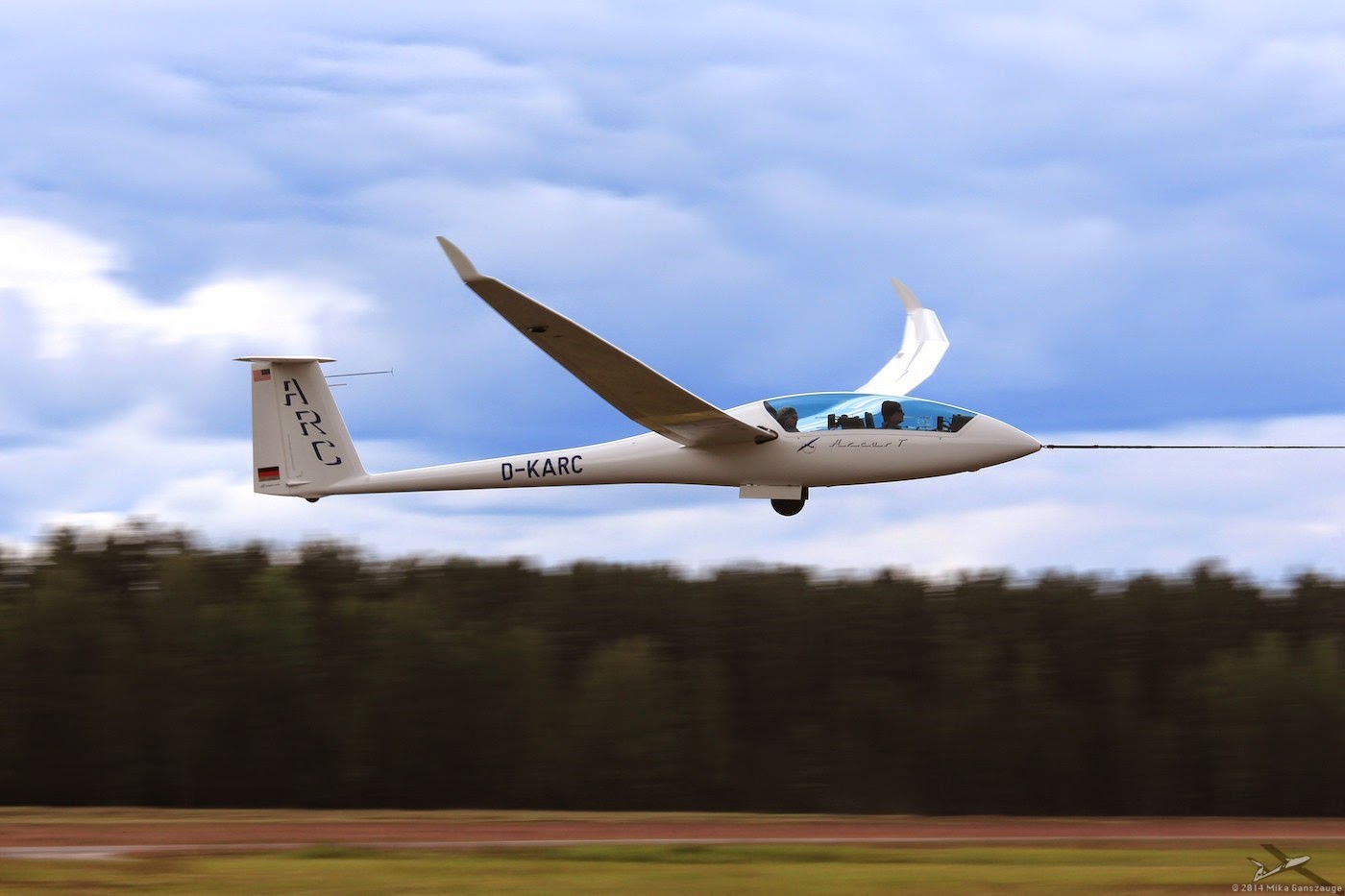
Heinz Weissenbuehler and Karin Schlosser - Arcus T

Garret Willat - Hornet
 
Sean Franke - Cirrus
 
Preliminary results are available here:


Tuesday, June 24, 2014

Gorgeous skies only 100km south of Räyskälä!


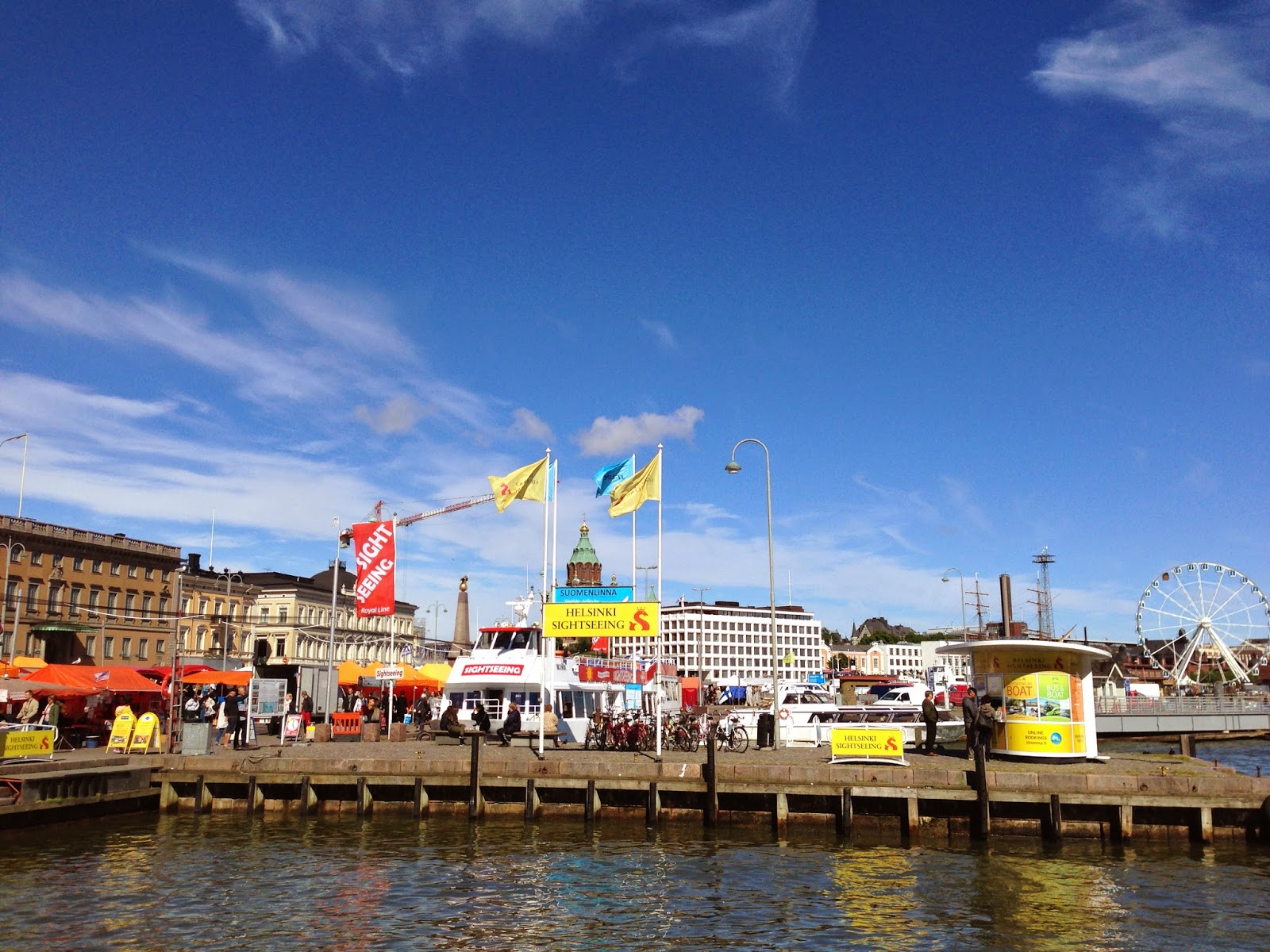
Please enjoy these pictures from our day trip to Helsinki:


We grid and wash the gliders...


WGC2014 – Rayskala, Finland
24 June   (Third scheduled competition day)
by John Good

Rules for today’s report preclude any adverse comments relating to Finland weather.  So I can mention that we gridded all gliders today and made a valiant attempt to fly, but that no actual motorless aviation resulted.  The reason for this is left to the imagination of the reader...

 
I believe these rules do not enjoin me from taking up such subjects as the relative effectiveness of cloth towels vs. plastic squeegees in removing moisture from smooth composite aerodynamic surfaces.  As it happens, we collected considerable data on this today, and (based on today’s and previous experiments) I’m definitely in the squeegee camp.  Note that quality squeegees are more common than is generally supposed: nearly all motor vehicles have two, in the form of windshield wipers.

I can mention that we had about the warmest weather yet seen at Räyskälä – high temperature was around 60F.  And we are told that this trend may continue.

It’s been noted that I’m behind on reports of bird sightings.  Räyskälä hasn’t yet produced much notable news on this front, though we regularly see a pair of Eurasian Cranes in a field near our eastern lake.  Other common sightings are Wagtails, Hooded Crows, and Cuckoos.  An Osprey was seen flying over the gridded gliders today.

At 10pm, another significant dose of the Precipitation that Must Not be Mentioned is falling, so I’ll end this short report in hopes of being able to report something better tomorrow.